S125-LP-DAC passive copper cable assemblies provide high-performance, cost-effective connectivity solutions for 1 Gbps Ethernet and 1 Gbps Fibre Channel applications. These cables enable hardware manufacturers to achieve high port density, flexible configuration and efficient port utilization while maintaining low costs and reduced power consumption.Designed to deliver reliable high-speed data transmission, these cable assemblies meet or exceed industry standards for Gigabit Ethernet and Fibre Channel in terms of performance and reliability. They are classified as passive copper cables because they do not contain signal conditioning circuitry, such as crosstalk or echo cancellation, within the SFP connectors. They are also commonly known as DAC (Direct Attach Cable) cables.S125-LP-DAC cable is a good alternative to link 1 Gbps SFP ports, with low-cost, low power consumption and low latency.
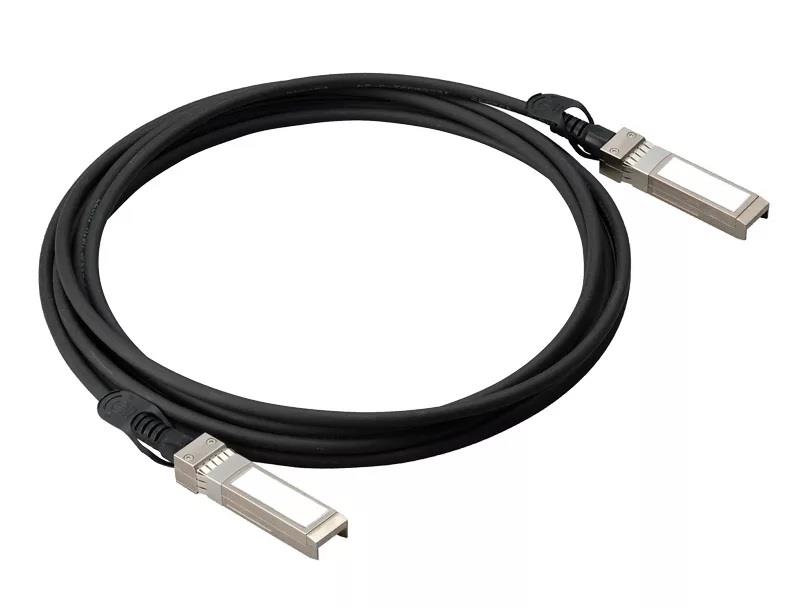
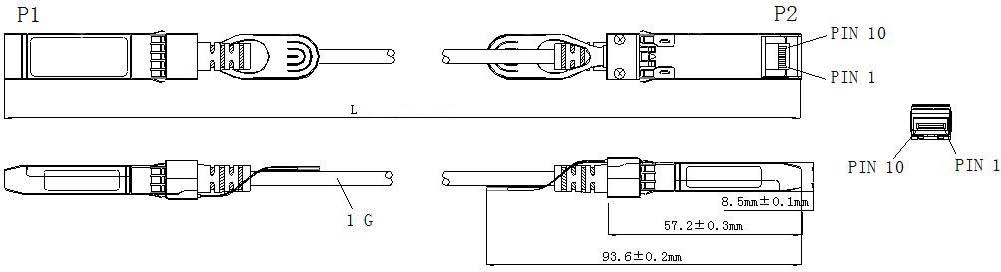
S125-LP-DAC 1.25 Gbps SFP Direct Attach Passive Cable
- Support for multi-gigabit data rates up to 1.25 Gbps Ethernet
- Cable type: Passive Copper Twinax Cable
- Wire AWG: AWG30, AWG26
- Hot-pluggable SFP 20 PIN footprint
- Available lengths: 1 m to 10 m
- Maximum power consumption < 0.1 W
- Improved Pluggable Form Factor (IPF) compliant for enhanced EMI/EMC performance
- Compliant with applicable SFP+ MSA spec.
- Commercial temperature range: 0 - +70 °C
- Electrical interface compliant with SFF-8431
- RoHS compliant
| Parameter | Min. | Typ. | Max. |
|---|---|---|---|
| Data rate per lane | 1.25 Gbps | 1.25 Gbps | |
| Operating case temperature | 0 °C | + 25 °C | + 70 °C |
| Relative humidity | 5 % | 95 % | |
| Supply voltage | 3.15 V | 3.3 V | 3.45 V |
| Description | Value |
|---|---|
| Electrical | |
| Min. dielectric withstand voltage | 300 V DC |
| Insulation resistance | 1000 MΩ |
| Current rating | 0.5 Amp Min/Signal Contact |
| Cable | |
| Conductor | Solid |
| Wire gauge | AWG30, AWG26 |
| Impedance | 100 ± 5 Ω |
| Cable OD | AWG 30: 4.2 mm AWG 26: 5.2 mm |
| Jacket type | PVC |
| Bend radius | 5 x cable outer diameter (OD |
- 1 Gbps Ethernet
- End of row/Middle of row switching architectures
- Switched fabric I/O such as ultra high bandwidth switches and routers
- Data center cabling infrastructure
- High density connections between networking equipment
- Storage Area Networks (SAN) & Storage Servers
 ACT_18-26_EN-1G-SFP-DAC